
TOURS
Visit Argentina !
Contact us for pre / post meeting tours
info@isa2026.com.ar
HOW TO GET TO BUENOS AIRES
Buenos Aires can be easily reached from many cities around the world. Teh city has two main airports: Ezeiza, located
30km far from the city center, and Aeroparque, located within the city limits by the river. Ezeiza handles mainly international
flights and Aeroparque handles mainly domestic flights. Direct flights are avaliable with the following airlines:
Aerolíneas Argentinas, Aeroméxico, Air Canadá, Air Europa, Air France, American Airlines, Arajet, Avianca,
Boliviana de Aviación, British Airways, China Eastern (from dic 2025), COPA, Delta, Emirates, Ethiopian, Gol, Iberia, ITA,
JetSmart, KLM, LATAM, Level, Lufthansa, Qatar, Sky, Swiss, Turkish, United.
TO/FROM THE AIRPORTS
Both airports are usually reach by taxi, Uber or Cabify. There are also buses that serve both airports, but they take much
longer to get to the city. No trains or subways are available at any airport.
VISAS
Some countries need a Visa to enter Argentina. They must be managed at ther argentinian embassies abroad, unless
the passport holder has a valid visa for the United States of America that enables the use of the AVE Global Turista
Programme. For more information about visa requirement check the following links:
https://www.migraciones.gob.ar/accesible/indexdnm.php?visas
https://www.migraciones.gov.ar/ave/
MONEY
The valid currency in Argentina is the Argentine Peso. Check the conversion to any desired currency at:
https://www.themoneyconverter.com/USD/ARS
TRANSPORT IN BUENOS AIRES
Buenos Aires is very flat city, and almost any place could by reach by foot. Nevertheless it is also quite big and means of
transports are usually necessary. There are 6 metro lines, many lines of buses (locally called “colectivos”), taxis,
Uber and Cabify. Some metro lines can be paid directly with a credit card, but there is also card valid for buses and metros
called SUBE. It can be bought at metro stations or Kiosks.

Bariloche
Bariloche is the gateway to the Lake District of Argentina and was the first city to be established in Patagonia, located west of the province of Río Negro. It is located in the heart of the Nahuel Huapi National Park, the oldest national park in the country. Located south of the lake that gives its name to the park, the destination combines both the city lifestyle and the tranquility of nature.
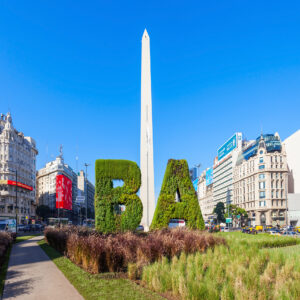
Buenos Aires
Buenos Aires, often called the “Paris of South America,” is a captivating tourist destination known for its rich blend of European elegance and Latin American vibrancy. Known for its passionate tango performances, colorful street art, and striking architecture, the city offers a range of experiences for all the senses. Visitors can savor mouthwatering steaks at traditional parrillas, explore the bustling markets and boutiques, and immerse themselves in the city’s thriving arts and culture scene. Get ready to experience a dynamic mix of history, culture, and gastronomy in a cosmopolitan setting!
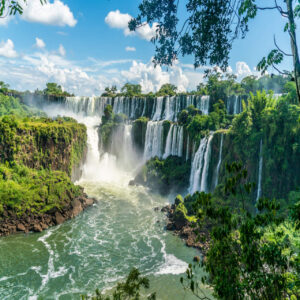
Cataratas de IGUAZÚ
Iguazú Falls is an enormous waterfall that lies on the border between Argentina and Brazil. Unlike many places in Argentina or Brazil, the name isn’t Spanish or Portuguese. The word iguazú actually derives from the Tupi or Guarani languages, meaning ‘big water’ – which is fitting, considering the falls’ sheer scale. Iguazú Falls is one of the most spectacular waterfalls in the world, with a multi-story cascade that stretches over 1.7 miles. If you break it down, Iguazú Falls actually comprises 275 separate waterfalls, with heights varying from 200 feet to 269 feet.
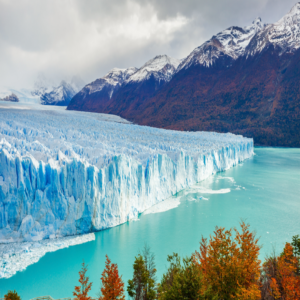
El Calafate
This city, located near the Cordillera de los Andes, is the top destination that hosts international tourists arriving in Patagonia, eager to see the stunning Perito Moreno Glacier, among other beautiful sights, in the UNESCO World Heritage Site of Los Glaciares National Park. El Calafate used to be a remote town and has since grown exponentially as Patagonia has evolved; becoming what is now recognized as the most important tourist city in Santa Cruz, with a stable population of about 25,000 inhabitants, excellent attractions and accommodations, and quality services of all kinds available year round.

Ushuaia
Ushuaia, the youngest of Argentina’s republic territories, is the capital of Tierra del Fuego, Antártida, and Islas del Atlántico Sur province. The island (Isla Grande de Tierra del Fuego) is separated from the rest of the continent by the Strait of Magellan, which belongs to Chilean territory. Often referred to as “The End of the World”, Ushuaia is the gateway connection for Antarctica-bound cruises. Surrounded by Magallanic subpolar forests trimming the Martial Glacier range, the city is also the perfect base camp for exploring the surrounding landscape: majestic forests, lakes, rivers, and mountains.
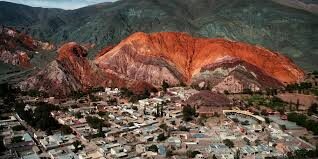
Northwest (Salta and Jujuy)
Northern provinces feature traces of pre-Columbian cultures, mingled with ruins of native’s villages, as well as forts and constructions back to the time of the Conquest and Colonization. Time seems to stand still in the high plateau of the Puna, a land full of mountain ranges, steep mountain paths, and gorges. Villages have been built in the small valleys. The region offers landscapes full of contrast for tourists to enjoy, from the high peaks to the plains, the salt pans, where Latin American culture took root.